From Unlock15
Jump to: navigation, search
No edit summary
No edit summary
 
(One intermediate revision by the same user not shown)
Line 1: Line 1:
{{#tweekihide:firstHeading|sidebar-right}}{{#arraymap:Evidence,Vision,Action
{{#tweekihide:firstHeading|sidebar-right}}
Welcome to the UNLOCK15-Toolbox - we are collecting tools to empower „agents of change“ from civil society as well as city officials to unlock existing lock-ins. We hope you will find some relevant tools to drive change towards mobility transition in your context!
 
From experience, three types of tools are need for real change: tools to create and communicate evidence, tools to envision possible futures and scenarios and participatory tools for on-site action.
 
{{#arraymap:Evidence,Vision,Action
   |,
   |,
   |xxx
   |xxx
Line 5: Line 10:
     |links=
     |links=
     |title=xxx
     |title=xxx
     |query=[[semorg-toolbox-tool-type::xxx]]
     |query=[[semorg-toolbox-tool-type::xxx]][[semorg-toolbox-visualisation::+]]
     |card template=toolbox
     |card template=toolbox
     |nopagination
     |nopagination
     |limit=3
     |limit=3
     |order=rand
     |order=rand
   }}[[xxx|Show all tools for xxx…]]
    |intro=<div class="mb-2">{{xxx-intro}}</div>
   }}[[xxx|more tools for xxx…]]
   |
   |
}}
}}

Latest revision as of 14:04, 19 May 2026

Welcome to the UNLOCK15-Toolbox - we are collecting tools to empower „agents of change“ from civil society as well as city officials to unlock existing lock-ins. We hope you will find some relevant tools to drive change towards mobility transition in your context!

From experience, three types of tools are need for real change: tools to create and communicate evidence, tools to envision possible futures and scenarios and participatory tools for on-site action.

Evidence
This type of tools help you to collect evidence, which supports the change you are aiming for. Some tools also allow crowd-based approaches to involve citizens in a broad manner. Evidence helps to convince decision makers to back-up change.
Author/Licence: Tobias Haider
Measuring the speed of public transport

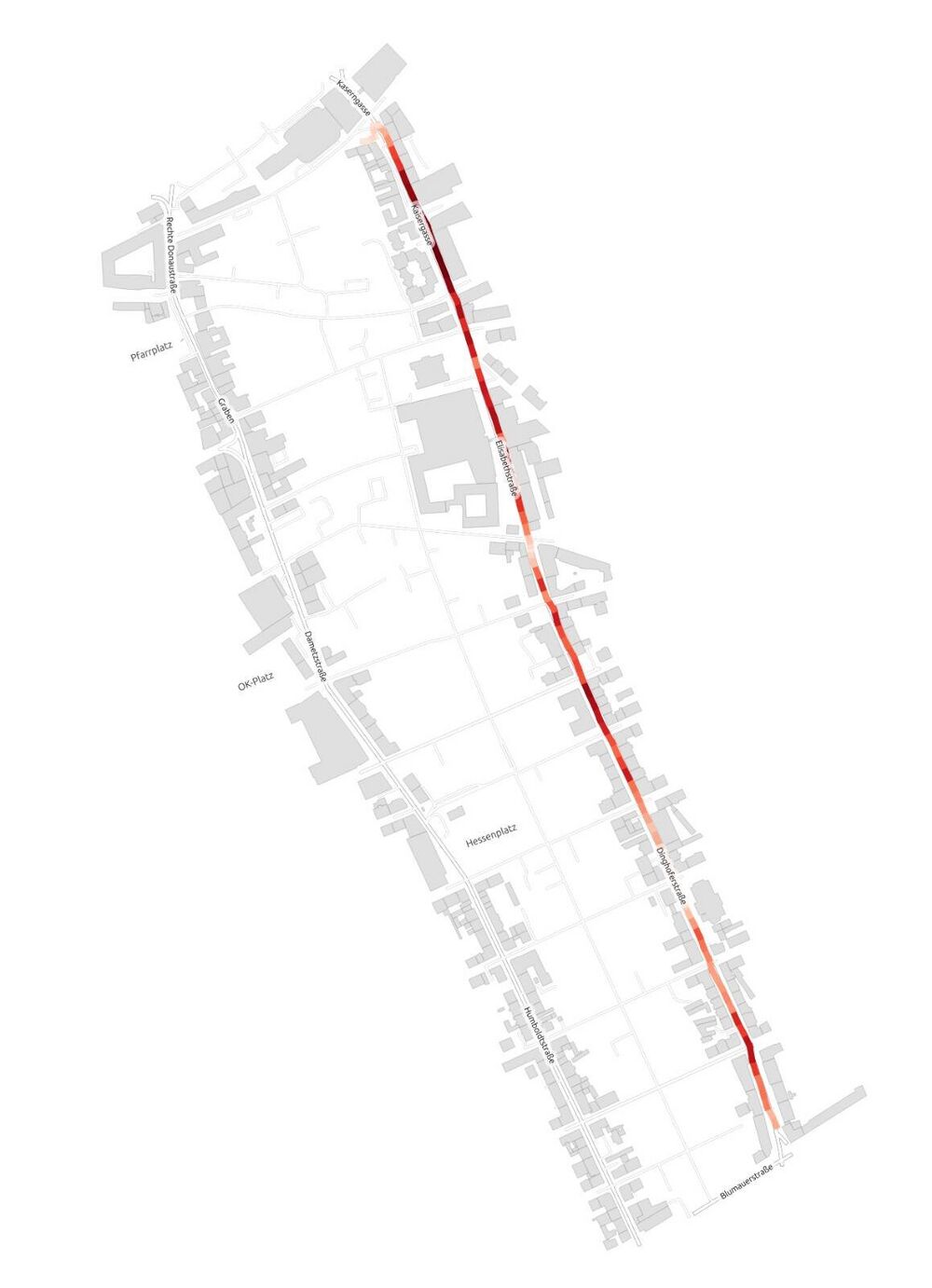
"We can’t reduce the speed limit on this road because the busses would loose time!“ This or similar arguments may come up in discussions about street transformations. In those situations, it can help to bring evidence into the discussion. For example by measuring the speed of busses. Think in advance how to make your data collection as valid as possible within your ressources. To produce solid evidence about the speed of public transport we suggest the following steps:

  1. Make a plan how you will collect your data: What do you want to measure (one busline in both directions between bus stop X and Y), when (on peak/off peak, which days) and how often (how many times per day)
  2. Install an App that collects GPX-Tracks (data that links speed with location)
  3. Ride the busses according to your data collection plan
  4. Find someone who knows how to use QGIS (open source program for making maps) and install the plug-in for GPX Segment importer (https://plugins.qgis.org/plugins/GpxSegmentImporter/#plugin-about)
  5. If everything works out the result should be maps like the ones you see here.
  6. Think about how you want to communicate the data: In a confidential setting or rather to a bigger audience?
Author/Licence: prostorož
Collaborative heat maps
Websites like mapperoni and uMap let you create maps with layers in a minute, embed them in your site or share them with others to contribute. An example: The urban design office prostorož invited citizens of Ljubljana in 2020 to vote for locations they experience as hot. In three weeks, they cast around 700 votes. The data was consistent with the locations of heat islands measured by satellite thermal imaging. The responses showed that people change routes and habits in the summer or avoid certain locations in the city altogether due to the heat. Respondents also suggested their own cooling measures - they want more and bigger trees, less asphalt, less concrete, and less parking spaces. This map was then published in newspapers and reached a big audience.
Author/Licence: Platz für Wien
Staging evidence for safer school streets
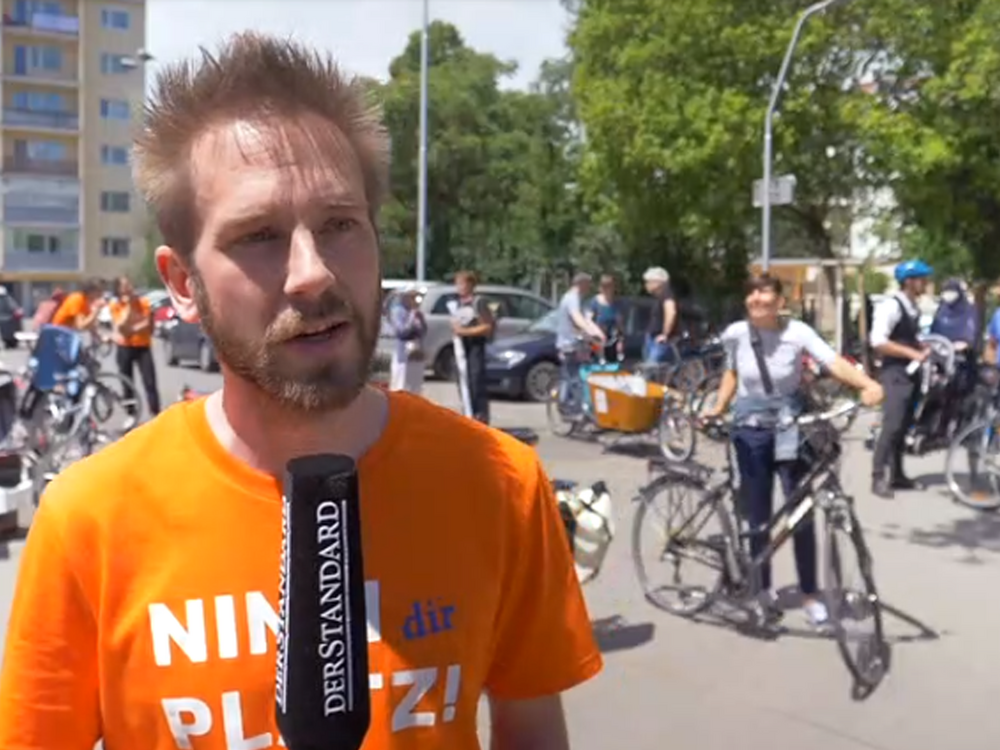
Excel sheets come to your mind when thinking of evidence? Think twice! The initiative "Wir machen Wien" showed powerfully how to not only collect valuable evidence, but also how to stage it in a dramatic way. They counted bikes, pedestrians and cars in a street in front of a school. The data showed a vast majority of the users (422) use the street by foot or bike. Nevertheless, the street is designed for cars, that represent a minority of the users (47). They designed wooden signs that clearly showed this discrepancy to passers-by, which sparked conversations. They also staged a photo, that you can see attached. They used the photo in a press release, which made local newspapers cover the story.

more tools for Evidence…

Vision
In this category you find tools that help you to create a vision of what you are aiming for. A strong vision is key for driving change because it helps you to grow as a movement and to shift public opinions. This category also includes tools that help you envision how you want to work together as a group.
Author/Licence: Trello
A shared digital ToDo-List to get you vision on track
There are several digital to do lists out there, that can help you as a group to organise projects, assign tasks, set deadlines, and track progress collaboratively. Trello is free until ten collaborators, wekan and kanboard are completely open source.
Author/Licence: blooming cities
Make your city bloom! Before/After Visualization
An AI-based tool for demonstrating and visualizing street redesigns.
Author/Licence: Wellcome Trust
Public Engagement Onion

The Public Engagement Onion is a visual framework originally developed by the Wellcome Trust that maps the different levels and forms of public engagement — from broad, one-directional communication to deep, two-way collaboration.

Like the layers of an onion, the model moves from the outside in: the outer layers represent activities such as broadcasting information or raising awareness, where the engagement is relatively wide-reaching but shallow. Moving toward the center, activities become more interactive and participatory, culminating in shared decision-making and co-creation at the core.

more tools for Vision…

Action
Small steps towards the realisation of local change can help to make the vision tangible and also easier to be discussed. Tools for action help to make the impact of change tangible and involve local communities.
Author/Licence: Kouji Tsuru Udo
Regulars table for district politics and initiatives
In this format district politics and initiatives meet up in a casual setting. This benefits everyone: On the one hand politicans can efficently update several initiatives at the same time and get wind of citizens troubles related to urban space at an early stage. Initiatives on the other hand get insights and can discuss their visions and potential future collaborations.
Author/Licence: Platz für Wien
Presswork to spread your vision
Presswork helps you to spread your vision of change. With a little preperation and a good idea, your work could be covered in the local news by tomorrow. Attached you will find a guide in english and german for successful presswork.
Author/Licence: Gebietsbetreuung/ Stadt Wien
Platform for free meeting spaces
A simple, user-friendly tool for overview and booking of free spaces for use by initiatives.

more tools for Action…