From Unlock15
Evidence
Mapping and analysing facades
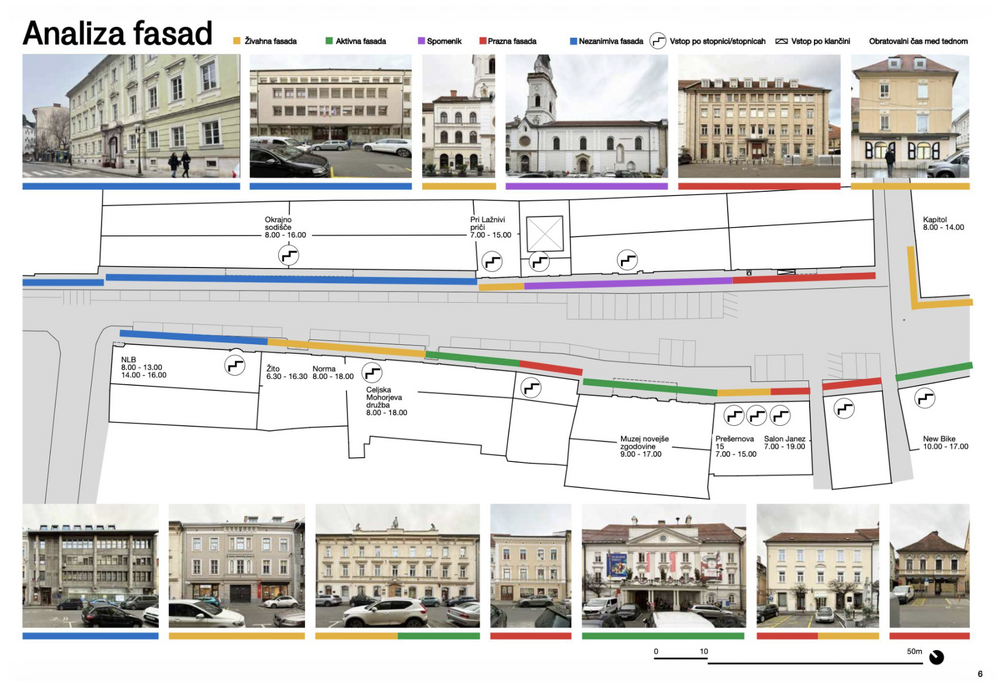
"We need parking space otherwise our shops will die!" This is an argument often brought forward by opponents of street transformation. The urban design studio prostorož confronted this claim with evidence. They analysed the facades of the street by the following categories: Lively facade, active facade, monument, empty facade, unremarkable facade. They could show that a lot of the ground floor was at that point in time not occupied.
prostorož combined this analysis with analysing parking place occupancy and human behaviour to build an even stronger argument: A street full of cars is not helping shops at the moment. By combining all these analysis they managed to convince the decision makers to give that street a human friendly makeover!Centralized participation plattform

"Mitgestalten.wien" is an example for a centralized participation plattform. We used it to run a survey for Unlock15 in Vienna about the future development of a street. "decidim.org" and "govocal.com" are plattforms that can help you set up a centralised participation plattform.
Observing and visualising human behaviour in public space
Collecting data on how people use space can give you a solid foundation to discuss how it should be designed. The free public live app helps you to collect the data you need when observing people. The second link leads you to a website where you can download an analog version with excel sheets. The picture is an example how you could visualise the collected data, done by urban design studio prostorož.
Vision
Public Engagement Onion
The Public Engagement Onion is a visual framework originally developed by the Wellcome Trust that maps the different levels and forms of public engagement — from broad, one-directional communication to deep, two-way collaboration.
Like the layers of an onion, the model moves from the outside in: the outer layers represent activities such as broadcasting information or raising awareness, where the engagement is relatively wide-reaching but shallow. Moving toward the center, activities become more interactive and participatory, culminating in shared decision-making and co-creation at the core.Efficient decision making in low hierarchy settings
Sociocracy is a governance and decision-making method designed to enable self-organization in groups and organizations without traditional top-down authority. Rather than relying on majority votes or hierarchical decisions, sociocracy is based on the consent principle: a decision is valid as soon as no member of the circle has a serious, well-founded objection — meaning arguments count, not the number of votes.
Make your city bloom! Before/After Visualization
An AI-based tool for demonstrating and visualizing street redesigns.
Action
Crowd Funding
Crowdfunding — and specifically civic crowdfunding — is an approach where communities, individuals, and organizations collectively finance local public projects through online platforms, often in combination with contributions from municipalities, foundations, or companies.
Tree Budget Graz
Tree budget Graz is an innovative financing model introduced by the City of Graz to systematically fund the planting and maintenance of urban trees. It draws from three sources: compensation fees collected under the city's tree protection ordinance (which requires replanting or financial compensation when trees are removed), voluntary tree sponsorships open to individuals and companies, and project-specific budget approvals by the city council. Together, these streams create a dedicated financial pool that ensures greening efforts are not dependent on a single, uncertain budget line.
New local collaborations to boost change!
Lack of funding or stuck in slow processes? Maybe a local collaboration can boost your vision to the next level! That happened to the Galileigasse in Vienna. Thanks to a collaboration between the district Alsergund, the Technical University Vienna and the LA21 the schoolstreet was completely transformed. A team of city planning and architecture students, their teachers and one carpenter planned and built the tactical urbanism elements within one semester. The district covered the cost for the material. The project cost a fracture of what it would have cost if a team of professional carpenters had done it.