
From Unlock15
Jump to: navigation, search
Vision
← All tools with a focus on: Evidence / Vision / Action
Author/Licence: Trello
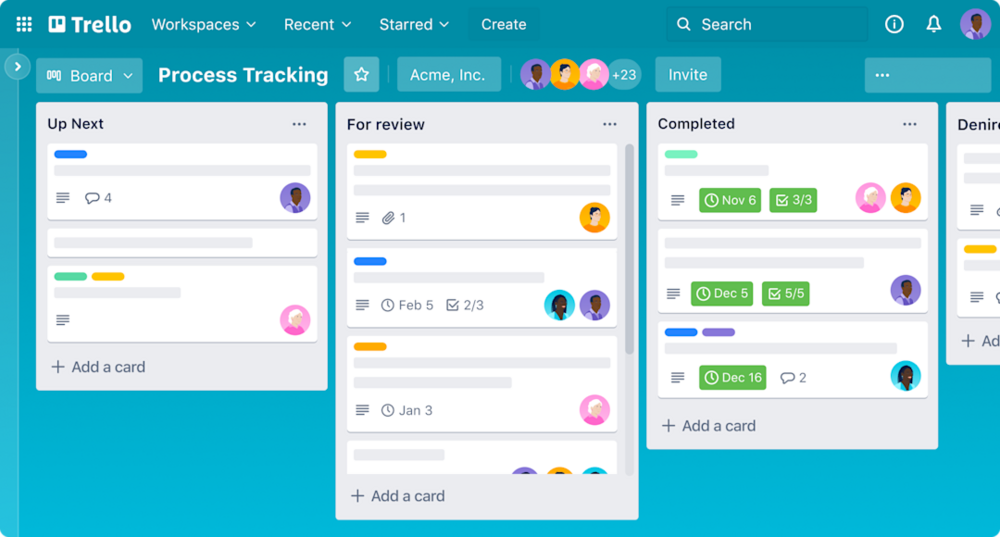
A shared digital ToDo-List to get you vision on track
There are several digital to do lists out there, that can help you as a group to organise projects, assign tasks, set deadlines, and track progress collaboratively. Trello is free until ten collaborators, wekan and kanboard are completely open source.
Author/Licence: Hannah Busing
Building durable groups with low hierachies

Defining goals, structures, roles and means of decision making are all crucial parts of founding and maintaining collectives, cooperatives, and other groups. Many aspects of organisation however remain ad hoc, informal and opaque, creating the possibility of power imbalances, misunderstandings and exclusion. The link will lead you to website with key questions that any group should consider and define during its formation.
Efficient decision making in low hierarchy settings

Sociocracy is a governance and decision-making method designed to enable self-organization in groups and organizations without traditional top-down authority. Rather than relying on majority votes or hierarchical decisions, sociocracy is based on the consent principle: a decision is valid as soon as no member of the circle has a serious, well-founded objection — meaning arguments count, not the number of votes.
Author/Licence: Stadt Wien / MA20
Learning public participation hub
The Vienna Climate Team is a participatory initiative in Vienna that brings residents, local stakeholders, and the city administration together to co-develop and implement climate protection measures at the district level. It enables citizens to submit ideas, collaborate with experts, and take part in decision-making processes related to urban sustainability.
Author/Licence: Paula von Krosigk
Local project advisory board
A local project adivsory board is made out of local people e.g. shop owners, residents as well as people from the administration. The various perspectives provided by the project advisory board are intended to help identify planning requirements at an early stage and to take them into account more effectively as the project progresses. They act, so to speak, as seismographs for the mood and needs within the neighbourhood.
Author/Licence: urbact
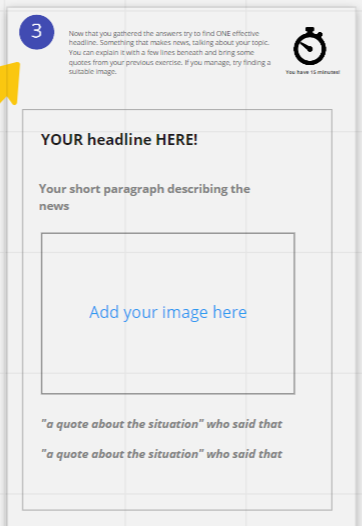
Newspaper of Tomorrow
When different stakeholders come together, they bring different perspectives. This is of great value for participatory and collaborative work. However, there is a risk that objectives and goals are different and difficult to combine. Creating a shared vision in the group becomes then an essential part of a project. This tool can be very helpful to reach this objective in a creative way.
Author/Licence: Maria Lin Kim
Onboarding framework

The Onboarding Framework is a structured yet flexible tool designed to help grassroots civil society initiatives welcome and integrate new volunteers with as little friction as possible.

The framework helps initiatives answer three core questions: What does a new volunteer need to know, feel, and do to get started? Where do their skills and interests fit best? And how can the organization make that first step feel easy, welcoming, and worthwhile?

By providing a clear path from curiosity to commitment, the Onboarding Framework reduces dropout at the earliest stage, builds a sense of belonging from day one, and ensures that volunteer energy is channeled effectively — strengthening the initiative's capacity from the bottom up.

Plenary for sharing emotions

A plenary for emotions is a structured group format that creates dedicated space for emotions and interpersonal dynamics within a collective or initiative — separate from task-oriented or decision-making meetings. Rather than pushing emotions to the margins of group life, the Emo-Plenum treats them as essential information: a signal about the health, motivation, and tensions within the group.

It is recommended to have a person that facilitates the plenary. This means guiding through the structure and keeping an eye on the time. This is how a Plenary of Emotions can be structured:

  1. Round: Each person expresses how they feel. In regards to the group but also in general. Resist the temptation to react to what has already been said and focus on yourself. The round is finished when everybody has shared something.
  2. Round: In the same order as before people can react to what has been said by others. The focus lies on validating and relating to emotions of others not jumping into problem solving mode right away. The round can go as long as people have to say something.
  3. Round: Collect next steps from what has been said. This can happen but doesn't have to.
Author/Licence: Wellcome Trust
Public Engagement Onion

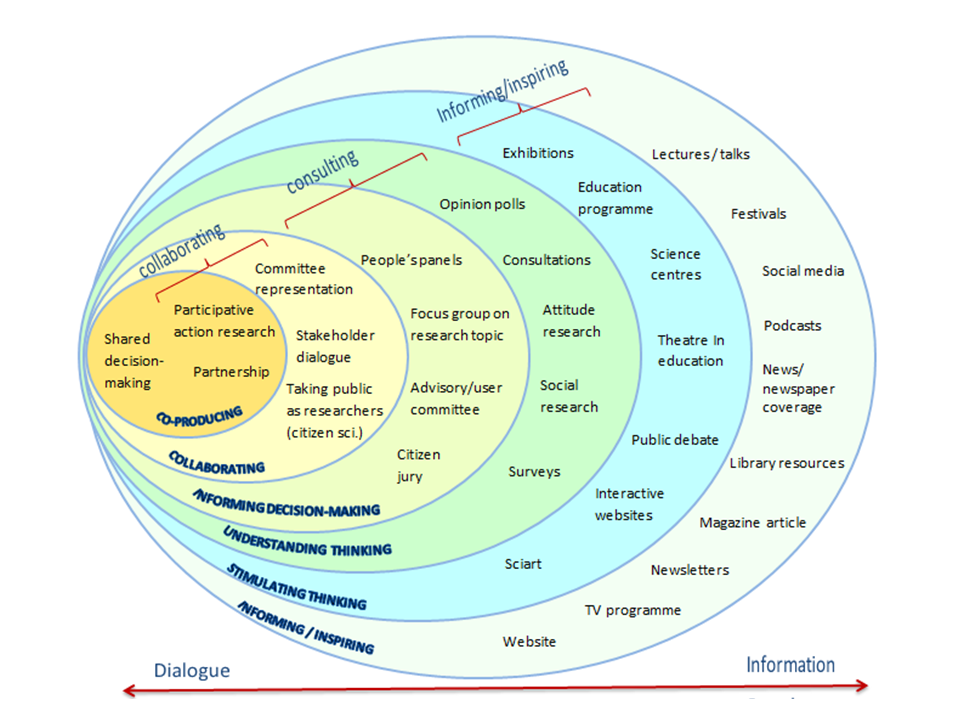
The Public Engagement Onion is a visual framework originally developed by the Wellcome Trust that maps the different levels and forms of public engagement — from broad, one-directional communication to deep, two-way collaboration.

Like the layers of an onion, the model moves from the outside in: the outer layers represent activities such as broadcasting information or raising awareness, where the engagement is relatively wide-reaching but shallow. Moving toward the center, activities become more interactive and participatory, culminating in shared decision-making and co-creation at the core.

Author/Licence: Antonia Janeski
Task & Maintenance: What makes groups work?

This tool is a quick, easy tool that is effective at helping groups understand the different roles in making groups work: different leadership skills.
Author/Licence: Slack
Tools to help communicate within a group
Communication platforms like slack or discourse have dedicated channels for different projects and teams, keeping discussions focused and easily searchable. On the scale of a small initiative they don't cost anything.